
27 Jul, 2026
See why forex brokerages need risk alerts with severity rankings, evidence logs, and complete investigation trails for faster compliance review and audit readiness.


Introducing Brokers (IBs) continue to be one of the most powerful growth channels in the Forex and CFD brokerage industry. While paid acquisition has become more expensive and increasingly regulated, IB networks still drive growth through trust-based and community-driven distribution.
However, not all IB systems are designed to scale. A multi-tier IB system transforms a simple referral model into a structured partner network. Instead of a flat “refer and earn” setup, it allows partners to build hierarchies, earn from downstream activity, and create scalable affiliate ecosystems.
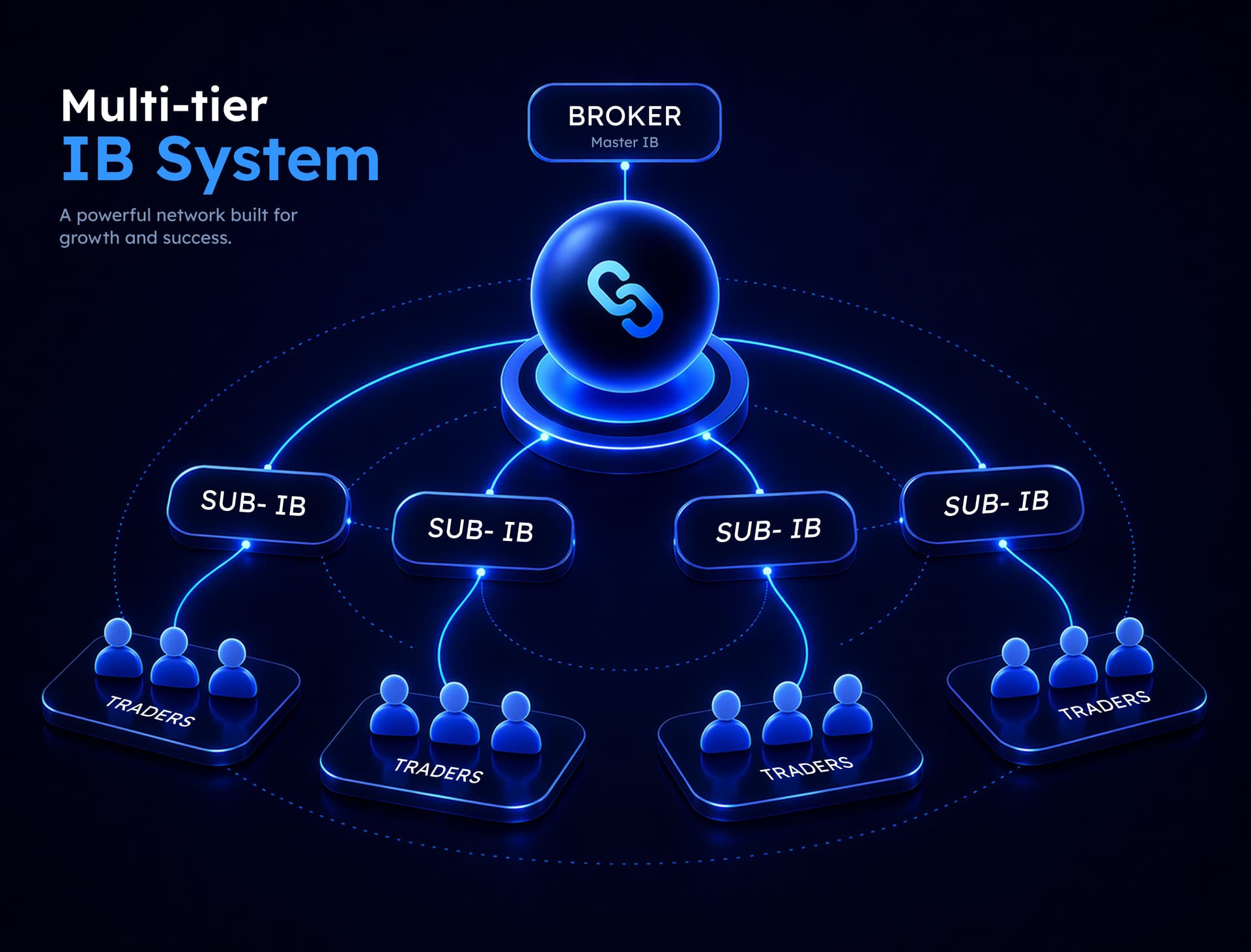
A multi-tier IB system is a structured partner hierarchy where commissions flow across multiple levels. In this setup, a master IB can recruit sub-IBs, who can further recruit traders or additional partners. Each level earns a portion of the trading activity generated within its network.
This creates a performance-based distribution structure rather than a single-level referral system. For example, a Tier 1 IB may directly partner with the broker, a Tier 2 IB may be recruited by Tier 1, and a Tier 3 IB may sit further downstream. Traders can be attached at any level, and commissions are distributed based on predefined rules. The system effectively turns IB networks into scalable growth engines.
A well-designed multi-tier IB system allows brokerages to expand partner networks without relying entirely on direct marketing. Instead of acquiring every client through paid channels, brokers enable IBs to become growth drivers themselves.
This creates compounding network expansion, reduces acquisition costs, and improves geographic reach as local IBs recruit within their own regions. It also leads to stronger retention, as traders introduced through IB networks often maintain closer relationships with their partners. At a structural level, it aligns partner incentives with trading volume, making revenue more predictable.
Multi-tier systems can be configured in different ways depending on the broker’s strategy. Some brokerages use fixed-depth hierarchies with a limited number of tiers. This approach provides cost control and predictable commission distribution.
Others use deeper or even unlimited structures, where commission percentages decrease at each level. While this allows aggressive expansion, it requires more advanced CRM logic to manage payouts accurately.
Another common approach is the differential model. Instead of assigning fixed payouts at each level, the broker defines a total commission pool and distributes the difference between tiers. This ensures that commissions remain controlled while still rewarding each level appropriately.
The IB compensation model plays a critical role in determining sustainability. CPA, or cost-per-acquisition, provides a fixed payout per qualified client. This model is attractive for aggressive affiliates but carries risks such as fraud and low-quality traffic. Revenue share models, on the other hand, align IB earnings with long-term trading activity.
Partners earn a percentage of the broker’s revenue, making the model more sustainable but less appealing for short-term acquisition strategies. Most modern brokerages adopt hybrid models that combine both approaches. A reduced CPA is paired with ongoing revenue share, balancing acquisition incentives with long-term retention.
Commission and rebate calculations are at the core of any IB system. Depending on the account type, brokers may operate on spread-based or commission-based models. In both cases, the CRM must calculate payouts accurately across all tiers.
In multi-tier environments, this becomes more complex. The system must account for downstream relationships, differential rates, and trading volume across multiple levels. Without automation, errors quickly emerge, leading to disputes and financial inconsistencies.
A scalable IB system cannot function without a strong CRM. The CRM is responsible for managing hierarchy structures, tracking trading activity, calculating commissions in real time, and automating wallet updates. It also synchronizes with trading platforms such as MT4, MT5, and cTrader to ensure that all trade data is accurately reflected in commission calculations.
Additionally, the CRM must support flexible rate configurations, allowing different commission structures based on account type, trading volume, or region. Automation is critical. Without it, reconciliation becomes unmanageable as the network grows.
As IB networks scale, brokerages encounter several challenges. Incorrect rebate calculations are common when systems rely on manual processes. Delayed payouts can damage partner relationships and reduce trust.
Fraudulent structures, such as self-referrals or circular hierarchies, can distort commission distribution.Lack of transparency is another major issue. IBs expect detailed reporting, and without a proper portal, dissatisfaction increases. These challenges highlight the importance of structured systems rather than ad-hoc setups.
Multi-tier IB systems must operate within regulatory frameworks. Certain jurisdictions impose restrictions on aggressive multi-level marketing structures or bonus-driven acquisition models.
A CRM must support compliance by managing IB verification, storing documentation, maintaining contract records, and logging all commission activity. Audit trails are essential, especially during regulatory reviews.
A scalable IB system is built on multiple interconnected layers. It requires integration with trading platforms, a commission engine capable of handling complex calculations, a hierarchy database to manage partner relationships, and a wallet system to track payouts.
It must also support real-time processing, high-volume trade ingestion, and flexible configuration for symbol-level and regional variations. Without this infrastructure, the system cannot scale reliably.
Transparency plays a key role in IB retention. A modern partner portal should provide a clear view of the entire network, including downline structures, trading activity, commission breakdowns, and performance metrics.
It should also allow IBs to generate referral links, access marketing materials, and track CPA performance. The more visibility partners have, the stronger their engagement becomes.
High-performance brokerages often extend their IB systems with advanced features. These include dynamic tier upgrades based on trading volume, performance-based bonuses, regional commission overrides, and symbol-specific payout structures.
Some also implement white-label IB programs and master agreements for sub-brokers. These features require a highly configurable CRM architecture.
The structure of an IB system directly affects a brokerage’s financial performance. When designed correctly, it stabilizes acquisition costs, improves marketing efficiency, and increases client lifetime value.
However, poorly structured systems can lead to margin compression, overlapping commissions, and increased fraud risk. IB architecture is not just a growth tool—it is a financial control mechanism.
A multi-tier IB system is more than a referral feature. It is a structured revenue architecture that defines how a brokerage grows. When implemented through a robust CRM, it enables scalable partner acquisition, automated commission distribution, transparent reporting, and sustainable profitability.
Brokerages that treat IB infrastructure as a strategic asset consistently outperform those relying solely on direct marketing. The difference lies in how well the system is designed, automated, and controlled.

See AltimaCRM in action.