
27 Jul, 2026
See why forex brokerages need risk alerts with severity rankings, evidence logs, and complete investigation trails for faster compliance review and audit readiness.


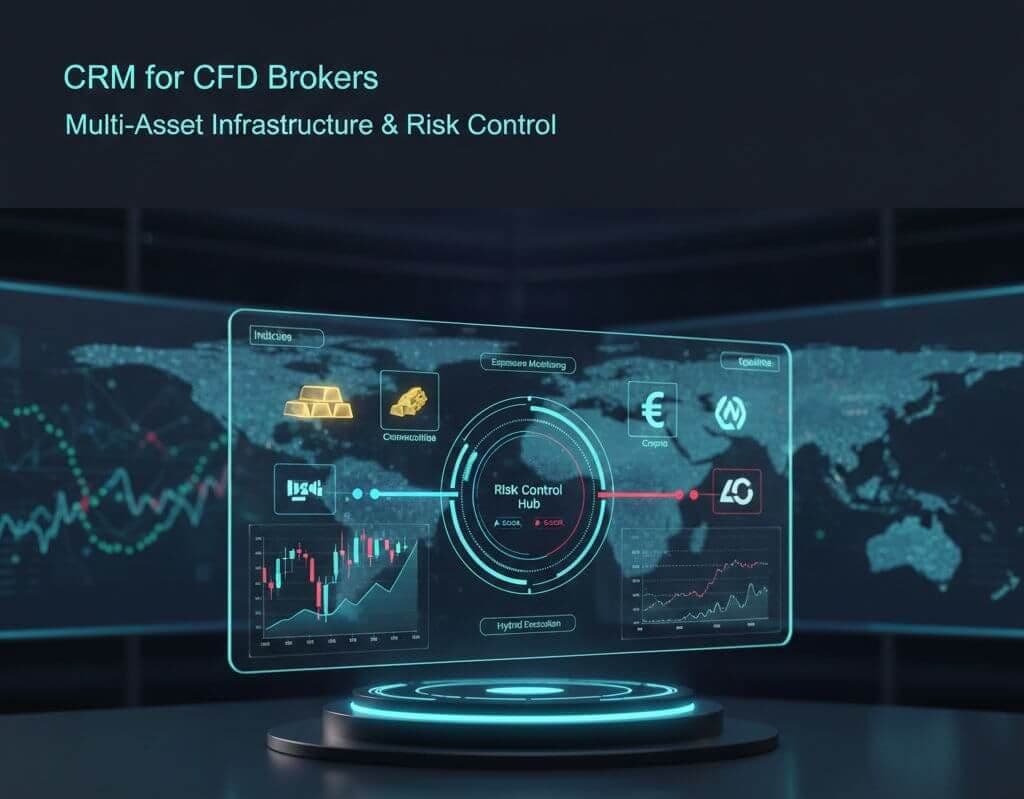
Contracts for Difference (CFDs) represent one of the most complex segments in online trading.
From the outside, a brokerage may appear to be a simple system where users register, deposit funds, and trade. In reality, it involves multiple interconnected layers—trading platforms, compliance systems, risk monitoring tools, payment infrastructure, and partner networks—all operating simultaneously.
At the center of this system is the CRM.
A CRM for CFD brokers is not a sales tool. It is the infrastructure layer that connects every operational component into a single, coordinated system.
A CFD CRM manages the entire lifecycle of a client, from onboarding to trading activity and financial reconciliation.
It ensures that all systems—trading, payments, compliance, and reporting—remain synchronized.
This includes handling:
The key value is not automation alone, but consistency across systems.
CFD brokerages operate under conditions that are significantly more complex than standard financial systems.
They must handle multiple asset classes, dynamic leverage models, and variable margin structures. They also deal with swap calculations, corporate actions, and strict regulatory oversight.
Because of this, generic CRM systems fall short.
They cannot accurately track revenue at the symbol level, manage cross-asset exposure, or align dealer execution with commission structures.
A specialized CRM is required to unify trading, risk, finance, and compliance into one operational framework.
Revenue in a CFD brokerage is not derived from a single source.
It comes from a combination of spread markups, commissions, swaps, and financing adjustments. Each of these must be tracked accurately across clients, symbols, IBs, and asset classes.
A strong CRM ensures that this data is consistently captured and processed, preventing revenue leakage and maintaining financial accuracy.
CFD brokers operate with dynamic leverage models that vary by asset class, region, and client profile.
The CRM must continuously track margin usage, stop-out levels, and leverage configurations. During periods of high market volatility, this becomes critical for preventing cascading risk.
Without proper monitoring, even small inconsistencies can lead to significant exposure.
A CFD CRM must integrate directly with platforms such as MT4, MT5, and cTrader.
This integration goes beyond account creation. It involves continuous synchronization of balances, trades, commissions, and market activity.
The trading platform handles execution, but the CRM governs how that data is interpreted and used across the business.
Modern brokerages cannot rely on delayed or batch-based systems.
A CRM must process trading data in real time, updating risk metrics, revenue calculations, and reporting instantly as activity occurs.
This ensures that decisions are based on current data, not outdated snapshots.
CFD brokers often operate hybrid execution models, combining A-Book and B-Book strategies.
The CRM plays a critical role in segmenting clients based on behavior, profitability, and risk patterns.
It allows brokers to:
This coordination is essential for maintaining balance between risk and profitability.
Introducing Brokers are a key part of CFD brokerage growth.
However, managing IB structures becomes complex due to variations in commission models, asset classes, and account types.
A CRM ensures that commissions are calculated accurately and reflect actual trading revenue.
This reduces disputes and improves partner trust.
A CFD CRM also manages financial operations.
It connects wallet systems, payment gateways, and trading balances into one synchronized structure.
This allows brokers to track deposits, withdrawals, and account balances accurately while identifying discrepancies in real time.
Regulatory requirements are a major factor in CFD brokerage operations.
A CRM must support identity verification, AML checks, transaction monitoring, and audit logging.
It also provides reporting across trading activity, financial performance, and client behavior, enabling both compliance and business decision-making.
As a brokerage grows, complexity increases.
More clients, more trades, more payments, and more partners all add pressure to the system.
A well-designed CRM allows the business to scale without losing control. It ensures consistency across operations and provides visibility into performance and risk.
A CFD brokerage is not just a trading platform—it is a multi-layered operational system.
The CRM is what connects those layers.
It brings together trading data, financial flows, risk management, and compliance into one unified infrastructure.
The depth of this system ultimately determines how efficiently a brokerage can operate and how well it can scale in a competitive market.

See AltimaCRM in action.