
27 Jul, 2026
See why forex brokerages need risk alerts with severity rankings, evidence logs, and complete investigation trails for faster compliance review and audit readiness.


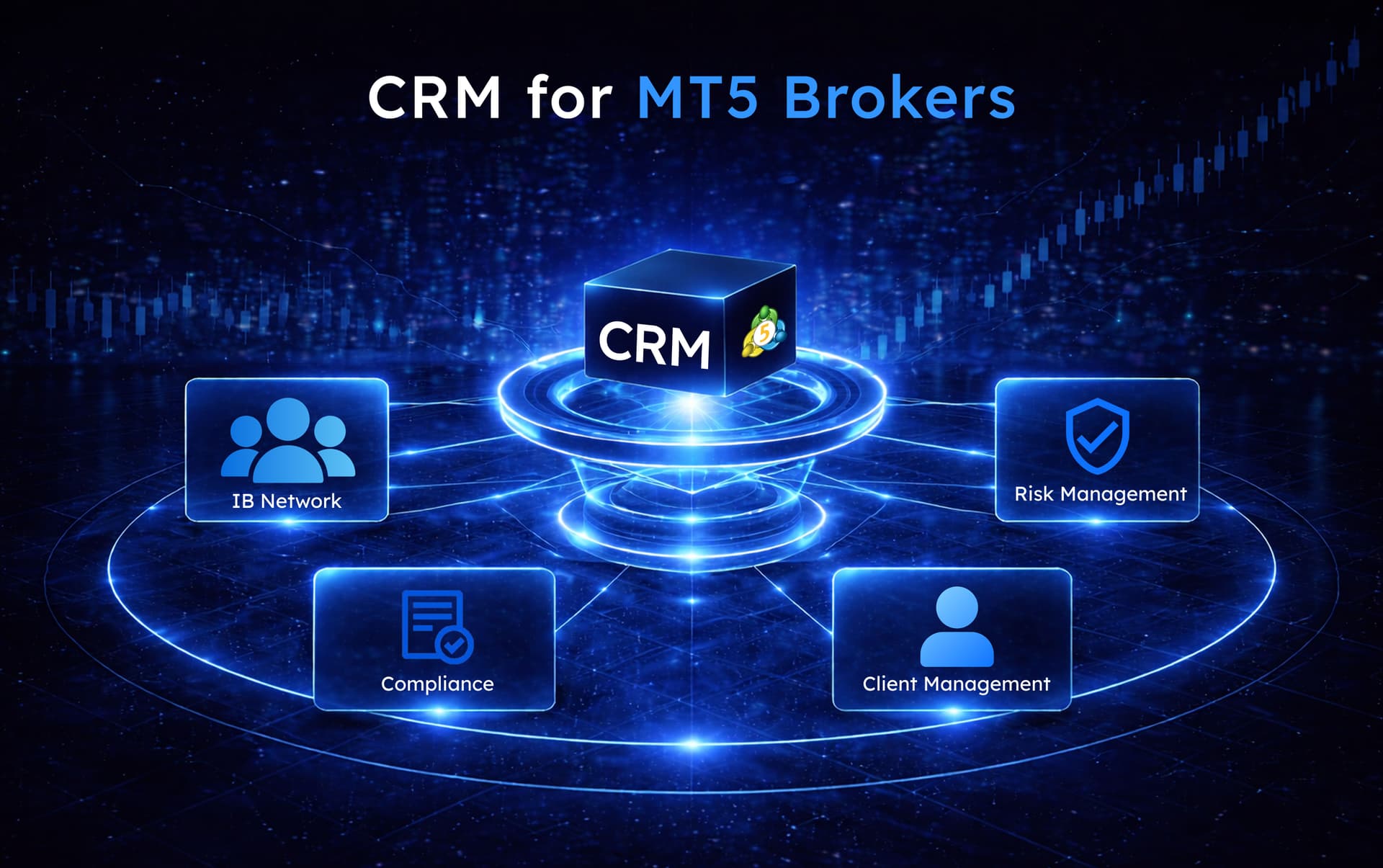
MetaTrader 5 is not merely a trading platform. It is a multi-asset trading system capable of handling Forex, CFDs, futures, stocks, and exchange-traded instruments with high performance. However, MT5 by itself does not provide the operational infrastructure required to run a brokerage.
A CRM for MT5 brokers acts as the operational system that connects the trading platform with back-office workflows. It manages client onboarding, compliance processes, account provisioning, payments, IB commissions, risk monitoring, dealer coordination, and reporting. Without a deeply integrated CRM layer, MT5 remains a trading terminal rather than a complete brokerage system.
A CRM for MT5 brokers is responsible for managing the entire operational lifecycle of a trader. This includes onboarding, KYC verification, account creation, wallet management, and payment processing. Once trading begins, the CRM must continuously synchronize trade data, commissions, balances, and reporting.
It must also ensure that all systems trading, finance, compliance, and risk remain aligned. This synchronization is what allows a brokerage to operate efficiently without fragmentation between departments.
MT5 introduces significantly more complexity compared to earlier platforms. It supports multiple asset classes, advanced margin systems, and both netting and hedging modes. It also relies on gateway-based liquidity connectivity and dealer-level execution control.
A generic CRM system cannot properly interpret MT5’s internal structure. It cannot map account groups, symbol configurations, commission layers, or dealer workflows accurately. It also cannot support real-time trade ingestion at scale. A specialized CRM is therefore required to act as the operational command center, translating MT5 data into usable business logic.
MT5 supports a wide range of asset classes, each with different contract sizes, margin models, swap rules, and commission structures. These variables directly affect revenue calculations and risk exposure.
The CRM must interpret these differences correctly when calculating IB rebates, volume-based incentives, and revenue reports. Without accurate mapping between trading data and financial logic, reconciliation errors and revenue leakage occur.
MT5 allows brokers to operate in either netting mode or hedging mode. In netting mode, positions are aggregated into a single entry per symbol. In hedging mode, multiple positions can exist simultaneously.
This distinction directly affects commission calculations and rebate logic. A CRM must detect the account type and adjust calculations accordingly. It must also handle partial position closures and trade aggregation accurately. Failure to account for these differences leads to incorrect IB payouts and financial inconsistencies.
MT5 environments are typically structured using multiple account groups, each with its own configuration. These configurations include leverage levels, commission per lot, swap settings, and trading permissions.
The CRM must map these group-level configurations into its internal logic. This ensures that revenue tracking, IB calculations, and exposure monitoring remain accurate across all account types.
MT5 does not operate as a simple API-driven platform. Integration requires working with the MT5 Manager API, gateway systems, and trading server architecture.
A CRM must handle account creation, balance adjustments, trade retrieval, and group assignments through persistent and secure connections. It must also implement retry logic, error handling, and high-availability mechanisms to ensure reliability. This level of integration is essential for maintaining operational continuity in a live trading environment.
A CRM for MT5 brokers must process both real-time and historical trade data. This includes trade execution details, commission values, swap calculations, and volume metrics.
High-volume brokerages require event-driven systems capable of handling continuous data ingestion. Delayed or batch-based processing is insufficient for accurate risk monitoring and financial reporting. Real-time synchronization ensures that all operational layers remain consistent at all times.
The CRM serves as the unified back-office system. It automates account lifecycle processes such as demo account creation, live account approval, leverage assignment, and group placement.
It also manages wallet systems and payment integrations. Brokers often operate centralized wallets, multi-currency balances, and internal transfers alongside MT5 account balances.
The CRM must reconcile trading balances, wallet balances, and payment processor records. Any discrepancies must be detected and resolved automatically to prevent financial misalignment.
Risk management is a critical component of MT5 brokerage operations. The CRM must monitor exposure across symbols, asset classes, and regions while tracking client behavior and profitability.
It must support segmentation into A-Book, B-Book, and hybrid execution models. This requires synchronization with dealer plugins and execution systems. The CRM must align its calculations with actual execution data, ensuring accurate revenue tracking and exposure visibility.
MT5 does not natively support advanced multi-tier IB structures. A CRM must manage partner relationships, track downstream accounts, and calculate commissions based on trading activity.
Commission models may vary across asset classes, account types, and pricing structures. The CRM must ensure that IB payouts reflect actual revenue generated from trades. Accurate IB management is essential for maintaining trust and preventing disputes.
A CRM provides decision-making insights by combining trading data, financial records, and client lifecycle information.
This enables brokers to analyze revenue by symbol, evaluate IB performance, track client profitability, and assess regional growth patterns. Without integrated reporting, decision-making becomes fragmented and unreliable.
MT5 brokerages often process large volumes of trade data across multiple servers and thousands of accounts.
A CRM must support scalable architecture, including queue-based processing, optimized databases, and horizontal scaling. System performance is directly tied to operational efficiency. Any bottleneck in CRM integration can impact trading operations and financial accuracy.
MetaTrader 5 provides trading capability, but it does not provide operational control. That responsibility lies with the CRM.
A properly designed CRM integrates trading, finance, compliance, and risk into a single system. It ensures that all components of the brokerage operate in alignment.
Without this infrastructure, operational gaps emerge, leading to inefficiencies, reporting errors, and increased risk. A CRM for MT5 brokers is not an optional tool. It is the foundation that enables a brokerage to function as a cohesive and scalable system.

See AltimaCRM in action.