
27 Jul, 2026
See why forex brokerages need risk alerts with severity rankings, evidence logs, and complete investigation trails for faster compliance review and audit readiness.


A forex brokerage is, at its core, a high-volume, high-churn, highly regulated sales business. You have a sales team chasing leads, a retention team stopping clients from leaving, a compliance team managing regulatory risk, a finance team processing deposits and withdrawals, and a marketing team running campaigns, all at the same time.
Without the right CRM, these teams operate in silos. Different tools, different spreadsheets, no single source of truth. Leads fall through the cracks. IB commissions get disputed. Reconciliation mismatches go undetected for weeks. Compliance gaps create regulatory exposure.
A contact database with a sales pipeline is not what a broker-grade forex CRM is. It functions as the brokerage's operating system, connecting front office lead management, back office trading account lifecycle, and the client portal into a single source of truth.
The brokerages that build profitably from day one are the ones that treat the CRM decision with the same seriousness as their licensing decision. Here's how to do that.
Before you evaluate a single CRM or trading platform, get clear on your operational model. The technology has to serve the business, not the other way around.
Your execution model shapes your CRM requirements directly.
Are you running A-Book, B-Book, or a hybrid? Most brokers in 2026 use a hybrid model, routing trades dynamically between internal and external execution paths depending on client profile, trade size, or strategy type. If that's your approach, your CRM needs built-in risk segmentation and the ability to sync client profiles with your dealer plugin in real time.
How dependent are you on IB networks?
If your growth strategy relies heavily on Introducing Brokers, you need a CRM with sophisticated multi-tier commission logic, not something bolted on as an afterthought. IB disputes are one of the most common operational headaches for growing brokerages, and they almost always trace back to a CRM that wasn't built for the complexity.
What's your regulatory environment?
A regulated brokerage needs detailed audit logging, KYC data storage, AML screening, and transaction monitoring baked into the CRM from day one. Beyond the trading platform, a forex brokerage relies heavily on operational software that manages the entire customer lifecycle, from lead generation and onboarding to compliance monitoring and client support. If your CRM can't support that, you're building on a foundation that will crack under regulatory scrutiny.
Which geographies are you targeting?
UAE, Europe, and Australia each carry different compliance requirements, payment preferences, and client expectations. Your CRM should support multi-jurisdiction workflows without requiring custom development every time you enter a new market.
Once these questions are answered, your technology decisions become significantly easier.
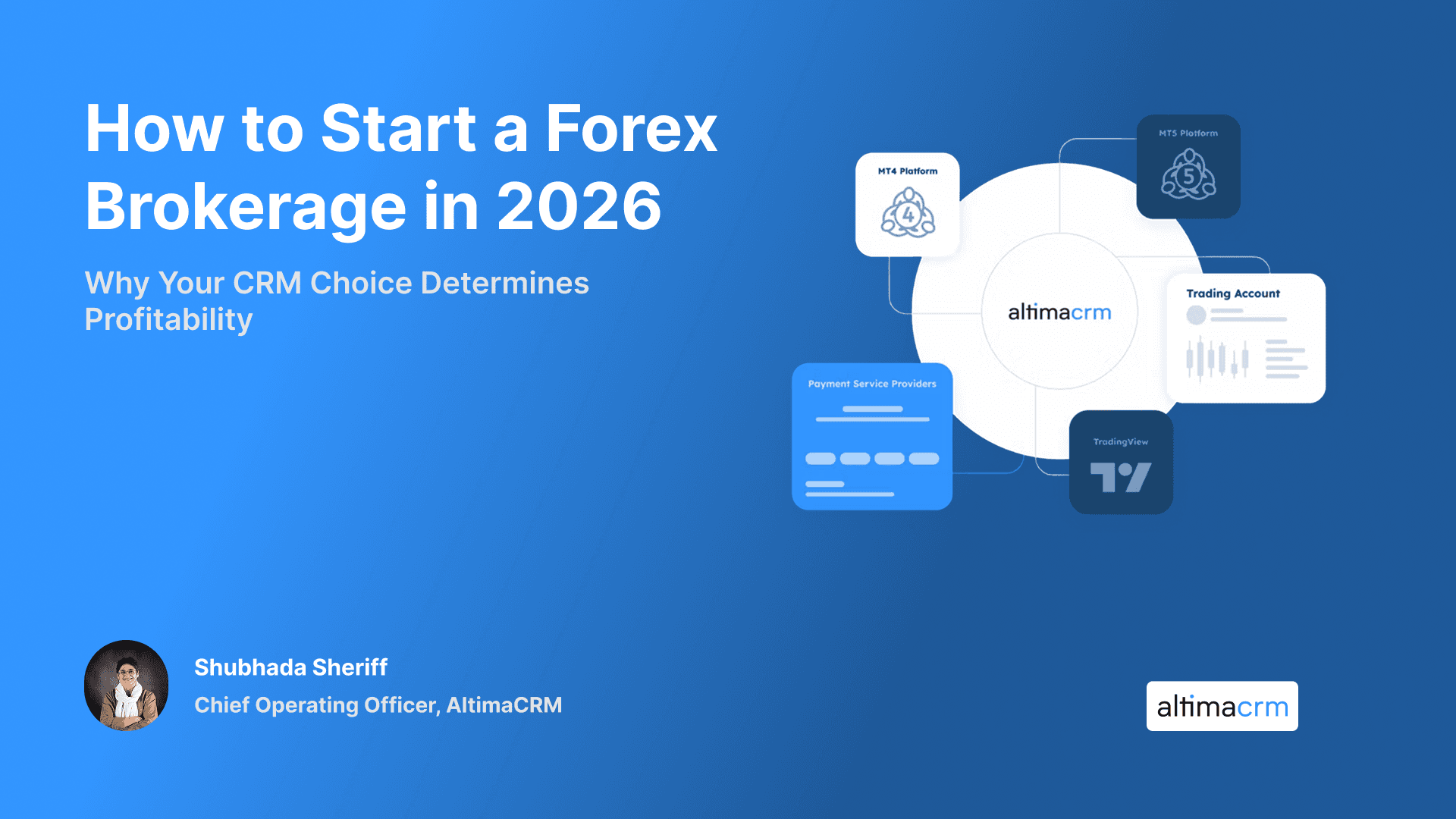
A forex brokerage runs on several interconnected systems. Understanding how they fit together is critical before you start making vendor decisions.
Trading platform: MT4, MT5, or cTrader. This is where your clients trade. Your CRM needs a native, real-time integration with whichever platform you choose. Without it, your sales and retention teams are operating blind.
Liquidity provider: your connection to the market. This is usually handled separately, but your CRM needs to interface with your bridge or dealer plugin for risk segmentation.
KYC and AML verification: regulatory requirement and operational necessity. Automated KYC through your CRM dramatically cuts onboarding time and reduces compliance risk.
Payment gateways: clients need to deposit and withdraw easily. Your CRM must handle multiple PSPs, log all gateway responses, auto-update wallet balances, and flag suspicious transactions automatically.
The CRM itself: the operational hub that connects everything above.
In 2026, a broker CRM is typically the operations hub that connects acquisition, onboarding, compliance, payments, trading-platform data, and IB/affiliate management in one place.
If the CRM can't connect these components cleanly, fragmentation sets in. And fragmentation costs you money, in manual reconciliation hours, in IB disputes, in compliance gaps, and in leads that fall through the cracks between systems.
One of the most common mistakes new brokerages make is treating client onboarding as a manual process. It doesn't scale and it creates consistency problems.
A proper CRM should automate the full account lifecycle: lead capture, email verification, document submission, risk profiling, compliance approval, live account creation, account group assignment, and leverage configuration, all without manual hand-offs between teams.
This matters for two reasons. First, speed. The faster a lead becomes a verified, funded trader, the higher your conversion rate. Every manual step adds friction and drop-off. Second, accuracy. Manual processes introduce misconfiguration risk, wrong leverage settings, wrong account groups, missed compliance checks. Automation removes that risk.
Wallet and balance synchronization is equally important. Modern brokerages run wallet-based systems where clients deposit into a central wallet and transfer funds to trading accounts. Your CRM must reconcile trading server balances, wallet ledgers, and payment processor records automatically, ideally on a daily basis. Discrepancies that go undetected quickly.
If you're planning to use Introducing Brokers as a growth channel, and most serious brokerages do, your CRM's IB module will determine whether that channel is profitable or a constant source of operational pain.
The basics: multi-tier IB structures, CPA models, revenue share, hybrid compensation, and commission configuration at the symbol level. Your CRM needs to handle all of this, because commission logic often varies across asset classes and account types.
Beyond the structure, what matters is accuracy. IBs drive a significant portion of brokerage revenue. Your CRM should handle multi-tier commission structures, automated rebate calculations, and provide dedicated IB portals. Without automated calculation, you're reconciling commissions manually at the end of every month, and introducing the kind of errors that damage IB relationships.
A strong IB module is also a growth tool. Brokerages that give their IBs transparent dashboards, real-time performance data, and automated payouts build better partnerships and grow their IB networks faster.
Compliance is not something you retrofit. If your CRM isn't built to support it from the beginning, you'll spend significant time and money patching gaps later, usually under pressure from a regulator.
For regulated brokerages, your CRM needs to support KYC data storage, AML screening, transaction monitoring, audit logging, and communication tracking. Regulators can request commission breakdowns, IB relationships, balance adjustments, and leverage change history at any time. That data must be accessible and accurate.
On the risk side, your CRM should support client segmentation by behavior and profitability, syncing A-Book/B-Book routing decisions with your dealer plugin. It should also provide real-time exposure monitoring by symbol, asset class, and region.
In 2026, regulatory scrutiny continues to intensify across major financial jurisdictions. A modern forex CRM serves as brokerage infrastructure rather than just a sales tool. Brokerages that treat compliance as an afterthought find this out the hard way.
When you're evaluating CRM options, don't start with the feature list. Start with the integration depth.
Trading platform integration, does it connect natively to MT4, MT5, and cTrader, or does it rely on third-party middleware? Native integrations mean real-time data; middleware introduces latency and failure points.
IB management depth, can it handle multi-tier structures, symbol-level commission logic, and automated payouts? Or does it require manual calculation?
KYC and compliance automation, are KYC workflows built in, or does it require a separate tool? Can it support multi-jurisdiction compliance without custom development?
Payment infrastructure, how many PSPs does it support? Does it auto-reconcile, or do you need to do that manually?
Reporting and business intelligence, can you see revenue by symbol, IB performance, client lifetime value, and marketing attribution in one place? Or are you pulling data from multiple systems into a spreadsheet?
Scalability, is the architecture designed for growth? Can it handle multi-server environments and high trade volumes without degrading performance?
Generic SaaS CRM tools, Salesforce, HubSpot, and their equivalents, were not built for this environment. They can manage contacts and pipelines. They cannot connect to trading data, automate commission structures tied to volume, or support compliance-specific workflows required in financial markets.
AltimaCRM is a forex CRM built specifically for brokerages, not adapted from a generic sales tool. With 18 years in fintech, 1.2 million leads managed, and 45,000 daily active users across 50+ brands, it is one of the most operationally proven platforms in the market.
The platform connects every team in your brokerage, sales, retention, compliance, finance, and management, on a single system. Sales closes more leads with complete client context. Retention catches at-risk traders before they leave. Compliance stays audit-ready without manual reporting. Management sees everything in real time.
More conversions. AltimaCRM's sales pipeline gives your team complete visibility into every lead, where they came from, where they are in the onboarding process, and what it will take to convert them. Automated follow-ups, omnichannel communication, and real-time trading data eliminate the guesswork.
Less churn. Retention teams can identify at-risk clients before they withdraw and leave. Behavioral triggers, trading activity alerts, and automated retention workflows give your team the tools to act before it's too late.
Less risk. AltimaCRM's compliance module keeps your KYC, AML, and audit trails clean and accessible. When a regulator asks a question, the answer is already documented.
Full IB infrastructure. Multi-tier commission structures, automated payout calculations, dedicated IB portals, and real-time performance dashboards, everything you need to build and scale a high-performing partner network.
Native MT4, MT5, and cTrader integration. Real-time account data, live balance synchronization, and automated account lifecycle management, without middleware and without delays.
AltimaCRM is not a software subscription. It is a growth infrastructure for forex brokerages that are serious about profitability.
AltimaCRM is the forex CRM that turns brokerage operations into a growth engine, so your sales team closes more, your compliance team stays protected, and your management team sees everything in real time.
The first 90 days are the highest-leverage period in your brokerage's lifecycle. Here's a structured approach that reduces operational risk during launch.
Month 1: Foundation. Select a CRM with deep trading platform integration. Configure account groups, leverage settings, and KYC workflows. Map your IB structure and connect your KYC provider. Do not go live until these are in place.
Month 2: Payment and risk infrastructure. Integrate payment gateways, configure wallet systems, and test reconciliation with real transactions. Enable exposure monitoring and verify that risk segmentation is syncing with your dealer plugin correctly.
Month 3: IB automation and reporting. Activate IB commission automation, deploy risk segmentation rules, configure reporting dashboards for all teams, and implement compliance logging. Run a full audit before accepting live clients at scale.
A structured rollout is not about going slowly. It's about going in the right order so you don't spend Month 6 fixing problems that should have been solved in Month 1.
These are not theoretical. They are the problems that show up in real brokerages, usually when it's too late and too expensive to fix cleanly.
Choosing the CRM after launch. By the time you realize the CRM doesn't support your IB structure or can't reconcile your payment data, you already have live clients. Migration is painful and costly.
Using a generic SaaS CRM. Salesforce and HubSpot are excellent tools for what they were designed for. Forex brokerage operations is not that. The integration limitations will compound as you scale.
Manual reconciliation. Every day you reconcile trading server balances, wallet ledgers, and payment records manually is a day you're exposing yourself to discrepancies that erode trust and revenue.
Weak IB structures. Underspecified commission logic means disputes. Disputes damage IB relationships. Damaged IB relationships slow growth.
Neglecting audit logging from day one. Regulators don't warn you before they ask for records. By the time you need the logs, it's too late to start collecting them.
Starting a forex brokerage in 2026 requires more than a license and a trading platform. The brokerages that scale profitably are the ones that build the right operational infrastructure from the beginning, with the CRM at the center of everything.
Choose the CRM that connects your teams, automates your compliance, scales your IB network, and gives your management team real-time visibility. Everything else follows from that decision.
If you're evaluating forex CRM options for your brokerage, explore AltimaCRM, built by operators who understand the brokerage business, not just the software.

See AltimaCRM in action.