
27 Jul, 2026
See why forex brokerages need risk alerts with severity rankings, evidence logs, and complete investigation trails for faster compliance review and audit readiness.


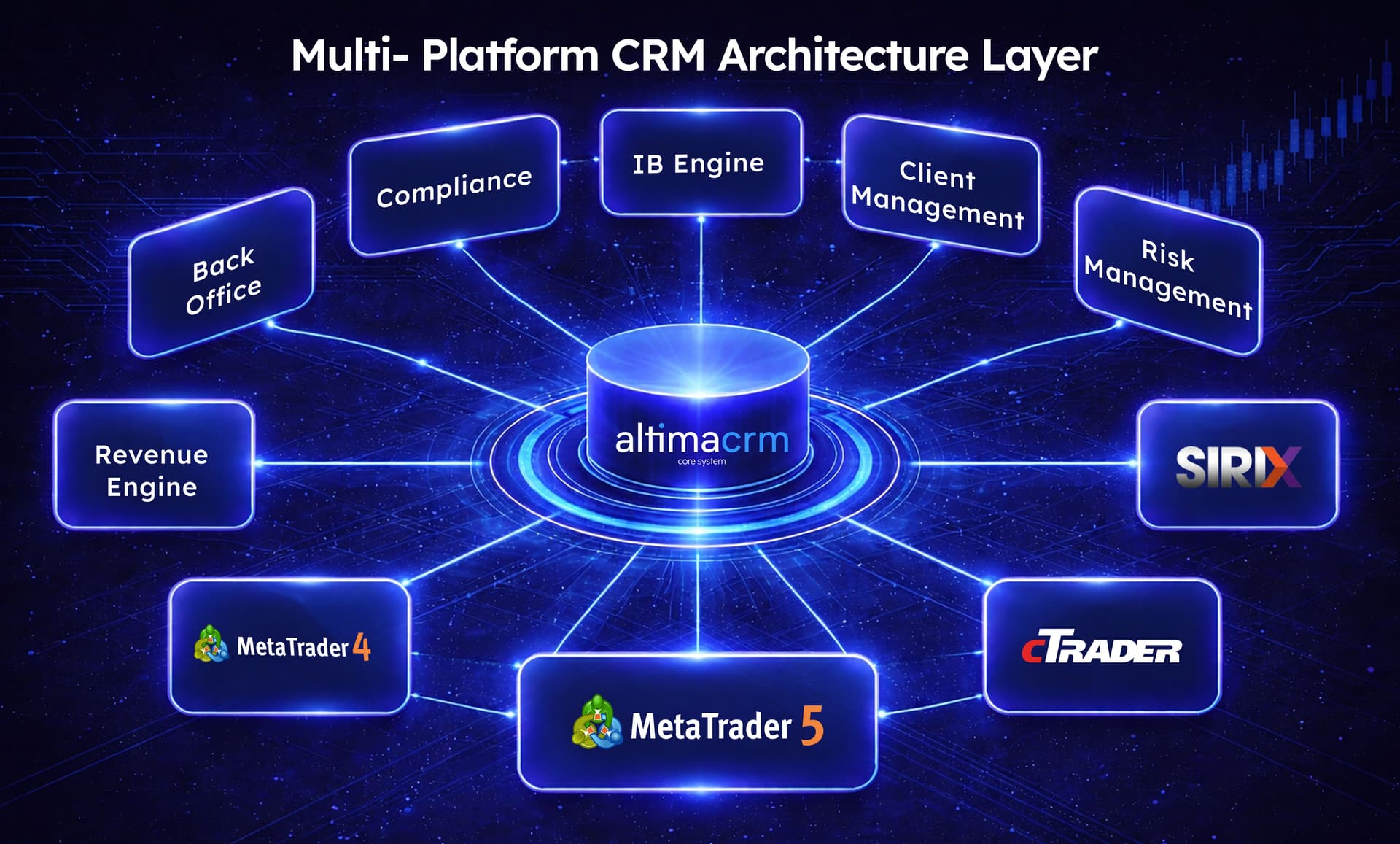
Every brokerage eventually reaches a point where change becomes unavoidable. You outgrow your existing setup. You expand into new asset classes. You move from MT4 to MT5. You introduce cTrader for specific client segments. You explore prop trading models or restructure your liquidity environment. On the surface, these are execution-level upgrades.
But internally, something far more critical happens. Your infrastructure is tested. For many brokerages, this is where the real problem begins, not with the trading platform itself, but with the CRM that was built around it.
A trading platform should be replaceable. It is a component of your business, not the foundation of it. However, many brokerages discover that their CRM is tightly coupled to the platform they started with.When a change is introduced, the impact is not limited to execution. It cascades across the entire operation.
IB structures must be rebuilt. Commission logic needs to be reconfigured. Historical performance mapping is disrupted. Compliance workflows lose continuity. Back-office operations become unstable. Teams require retraining, and data consistency becomes a real concern during migration.What should be a strategic upgrade turns into an operational risk. The issue is not the platform change itself. It is the dependency between the CRM and the platform.
Many CRM systems in the brokerage industry are not designed as independent infrastructure. They are often extensions of trading platforms, built as add-ons or thin integration layers around MT4 or MT5. In many cases, they are part of white-label ecosystems where critical logic is not owned by the broker. This architecture works in the early stages, but it introduces limitations as the business evolves.
When the CRM is tied to a single platform, operational logic becomes fragile. Commission structures need to be rebuilt manually. Client segmentation breaks.Automation rules fail. Reporting resets. Compliance workflows lose connection with trading activity.The deeper issue is architectural dependency.When you do not control your infrastructure, your ability to scale is constrained by it.
A brokerage should not need to rebuild its operations every time it changes execution infrastructure.
A platform-agnostic CRM is designed to sit above trading platforms, not inside them. It separates operational logic from execution systems, allowing each layer to evolve independently.This means that when a platform changes, the CRM does not need to be rebuilt.
Only the integration layer is updated.Client identity, commission structures, compliance workflows, and reporting remain intact. This approach transforms platform changes from high-risk events into controlled technical transitions.
Modern brokerages rarely operate on a single platform.
It is common to see MT5 used for primary execution, MT4 maintained for legacy clients, cTrader introduced for specific segments, and additional environments created for prop trading or custom liquidity setups.
In this environment, fragmentation becomes a real risk. A CRM must unify all platforms into a single operational layer. It must maintain centralized client profiles, consistent wallet management, unified compliance workflows, and consolidated reporting. Without this structure, each platform becomes its own silo, and operational complexity increases exponentially.
A platform-agnostic CRM ensures that your infrastructure remains stable, even as your execution environment evolves.It allows IB structures to remain intact across platform changes.
Revenue tracking continues without disruption. Compliance workflows stay consistent. Back-office teams continue operating within the same system.The only element that changes is the connection to the trading platform.This separation is what enables scalability without operational instability.
Platform migration is often seen as risky, and in many cases, that perception is justified.However, the risk comes from tightly coupled systems, not from the migration itself.
When the CRM is architected independently, migration becomes a controlled process. Data integrity is preserved because client records, financial data, and historical activity remain centralized.Operational teams do not need to relearn systems, because the back-office environment remains unchanged. Only the underlying execution mapping is updated.
Security is also maintained through structured architecture, including role-based access control, encrypted communication layers, and complete audit logging.This approach ensures that infrastructure remains resilient, even during periods of change.
The need for platform independence becomes even more critical in prop trading models. Prop firms rely on rule engines, challenge logic, and real-time evaluation systems that must operate consistently regardless of the execution environment.
A CRM designed with platform independence ensures that challenge tracking, rule enforcement, and performance monitoring remain stable, even if the underlying trading infrastructure evolves. This prevents disruption in evaluation systems and maintains operational integrity.
Platform-agnostic CRM architecture is particularly relevant for brokerages that are planning to migrate from MT4 to MT5, expand into multiple trading platforms, or introduce new business models such as prop trading.
It is also critical for teams that require operational continuity, including compliance departments that depend on consistent reporting and operations teams that manage daily workflows. For founders and technical leaders, it provides control over infrastructure rather than dependence on third-party systems.
Trading platforms will continue to evolve. Liquidity providers will change. Regulatory requirements will increase. Business models will expand. If your CRM is tied to a specific platform, every change introduces friction.
If your CRM is independent, change becomes manageable. A brokerage built on platform-agnostic infrastructure can adapt without disruption. It can evolve without rebuilding its operational core.
A Forex CRM should not be tied to a trading platform.It should be the system that holds everything together while the rest of the business evolves. Changing platforms should improve execution, not destabilize operations.
Brokerages that understand this build infrastructure that supports growth over the long term. Those that do not often find themselves rebuilding systems every time they try to move forward.

See AltimaCRM in action.